
How to Source FFPE Blocks for Research in India — Complete Guide | Biospecimen Solutions
Table of Contents
For cancer researchers, pathologists, biomarker scientists, and drug developers, FFPE tissue blocks are one of the most valuable and widely used biospecimen types in translational and clinical research.
They are a window into disease — preserved slices of human biology, archived from surgical procedures and biopsies, ready to yield DNA, RNA, protein, and morphological data decades after collection.
But sourcing high-quality FFPE blocks for research in India is not always straightforward. The quality of an FFPE block — and its usefulness for your specific assay — depends on how it was fixed, how long it has been stored, what clinical annotation accompanies it, and whether the supplier operates to a standard you can defend in a regulatory or scientific context.
This guide covers everything a researcher, pharma scientist, or biotech professional needs to know about FFPE block procurement India — from what FFPE blocks are and what they are used for, to how to find a reliable FFPE block supplier India and what quality criteria to apply.
What Are FFPE Blocks?
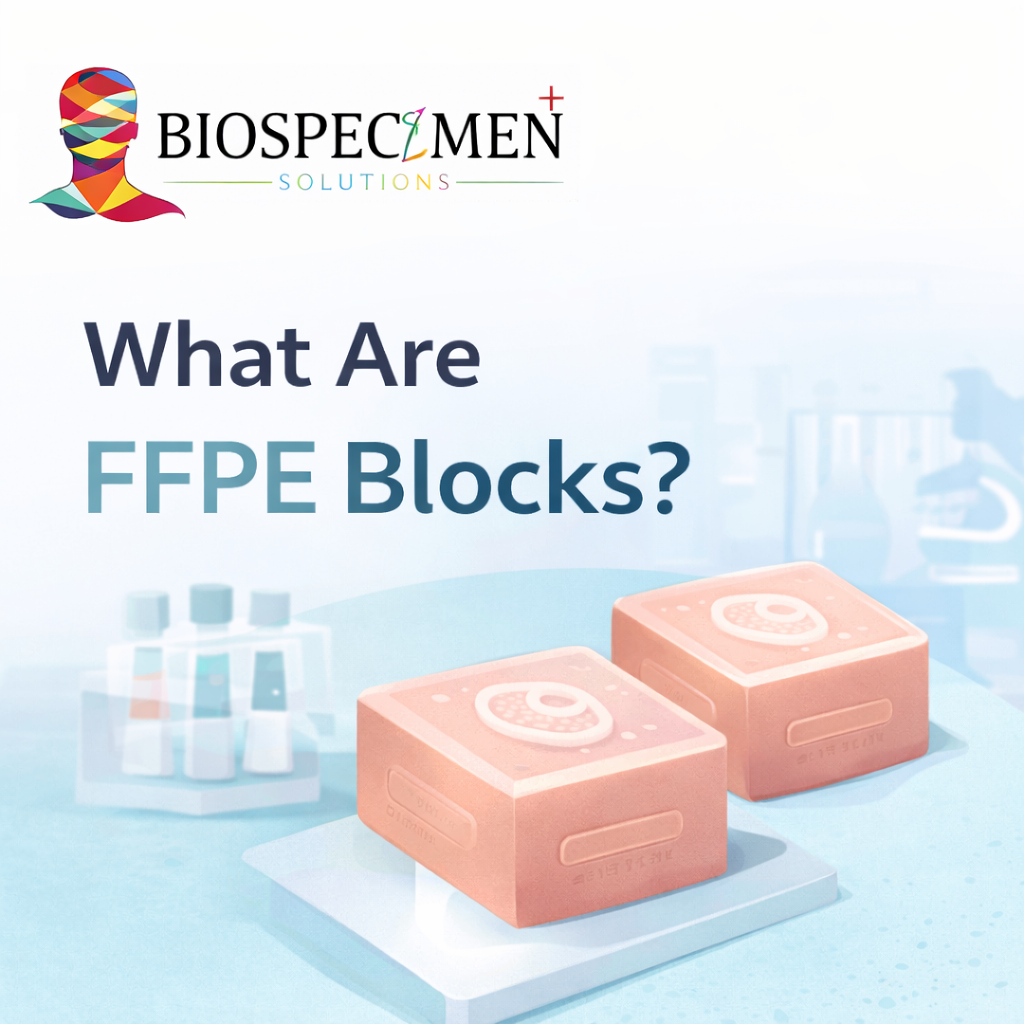
FFPE stands for Formalin Fixed Paraffin Embedded. FFPE blocks are tissue samples — typically from surgical resections, biopsies, or autopsies — that have been preserved through a two-step process:
Step 1 — Formalin Fixation The fresh tissue is immersed in formalin (formaldehyde solution), which cross-links proteins and halts biological degradation. This preserves the cellular architecture of the tissue in a state very close to its living form. Fixation time is critical — under-fixation leaves tissue vulnerable to degradation, while over-fixation can impair downstream molecular analysis.
Step 2 — Paraffin Embedding The fixed tissue is dehydrated through a series of alcohol and xylene baths, then infiltrated with molten paraffin wax. Once cooled and hardened, the tissue is embedded in a solid wax block — an FFPE block — that can be stored at room temperature for decades.
From an FFPE block, researchers can cut thin tissue sections (typically 3–5 microns) for:
- Histopathology — H&E staining for morphological assessment
- Immunohistochemistry (IHC) — protein expression analysis
- In situ hybridisation (ISH/FISH) — gene expression and chromosomal analysis
- DNA extraction — for targeted sequencing, NGS, or PCR
- RNA extraction — for gene expression profiling
- Proteomics — protein biomarker discovery
The combination of long-term stability at room temperature and the ability to yield multiple analytical outputs makes FFPE tissue blocks the most widely used archival biospecimen type in research globally.
Why FFPE Blocks Matter for Research in India
India has a significant and growing role in FFPE block research — driven by several factors:
Large Disease Burden Across Key Indications
India has one of the world’s highest burdens of cancer, cardiovascular disease, infectious disease, and metabolic conditions. This translates into large volumes of surgically resected tissue being generated annually across Indian hospitals and pathology departments — a rich resource for archived tissue samples India.
Genetic Diversity
India’s population represents extraordinary genetic diversity — across ancestral groups, geographic regions, and disease presentations. For global pharmaceutical companies conducting translational research, access to FFPE oncology samples India from genetically diverse Indian patients has significant scientific value.
Cost and Access Advantages
Sourcing FFPE blocks India through an established CRO is significantly more cost-efficient than equivalent access in Western markets — while the scientific and clinical quality of samples from accredited institutions is internationally comparable.
Growing Biobanking Infrastructure
India’s FFPE block biobank India infrastructure has grown substantially, particularly in metropolitan research and oncology centres. Accredited CROs like Biospecimen Solutions maintain large repositories of annotated FFPE blocks India with accompanying clinical data — enabling researchers to select samples with the specific disease characteristics their study requires.
What Are FFPE Blocks Used for in Research?
Oncology Research
FFPE blocks for cancer research are the dominant application. Tumour tissue from primary resections, lymph node biopsies, and metastatic sites — fixed and embedded — provide the cellular material for:
- Biomarker discovery and validation
- Companion diagnostic development
- Tumour heterogeneity studies
- Molecular subtyping of cancer
Archived FFPE tissue cancer India repositories hold samples across a wide range of malignancies — including breast, lung, colorectal, cervical, head and neck, gastric, and haematological cancers.
Genomic and Molecular Studies
FFPE NGS samples India — used for next-generation sequencing — have become central to precision medicine research. While RNA quality from FFPE is more challenging than from fresh-frozen tissue, advances in library preparation have made FFPE-derived NGS increasingly reliable. FFPE DNA extraction India for targeted sequencing panels and whole exome sequencing is now routine in well-equipped laboratories.
Immunohistochemistry (IHC) Studies
FFPE IHC samples India are used extensively for protein expression studies — assessing biomarker expression levels across disease states, patient populations, and treatment conditions. IHC on FFPE sections is the most widely used method for companion diagnostic validation.
Drug Development and Toxicology
Pharmaceutical companies use FFPE blocks pharma research to assess tissue-level drug effects, characterise target expression across disease subtypes, and generate histopathological data for regulatory submissions.
Matched Sample Studies
Matched FFPE samples India — where the same patient contributes tissue from different anatomical sites, time points, or disease stages — are particularly valuable for biomarker studies comparing primary vs. metastatic tissue, pre- vs. post-treatment samples, or tumour vs. adjacent normal tissue.
How to Source FFPE Blocks for Research in India — Step by Step
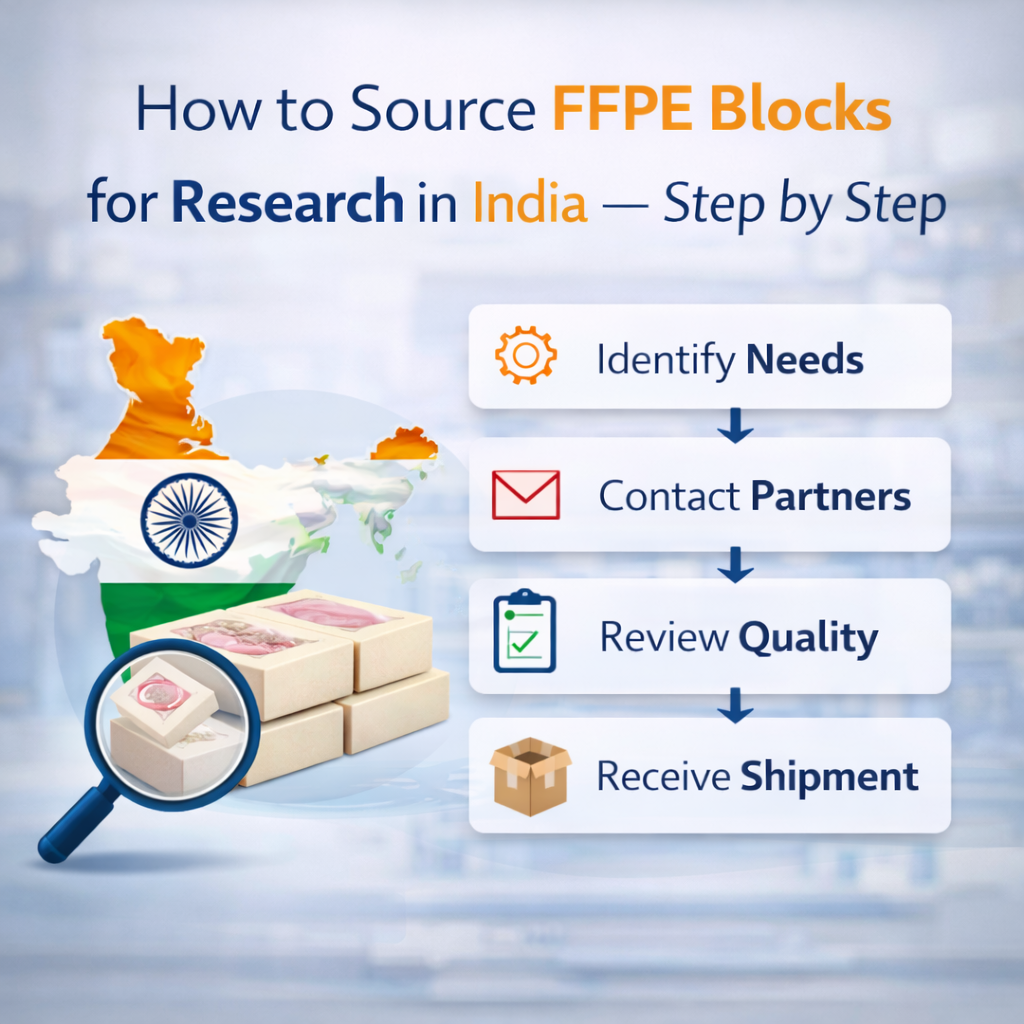
Step 1: Define Your Tissue Requirements Precisely
Before approaching any FFPE block supplier India, document your requirements:
- Disease indication — which cancer type or condition? Stage? Grade?
- Tissue type — primary tumour, lymph node, metastatic site, adjacent normal?
- Number of cases — how many individual patient blocks?
- Sections needed — how many sections per block? At what thickness?
- Downstream assay — IHC, FISH, DNA extraction, RNA extraction, NGS?
- Clinical annotation — what clinical data must accompany each block? (Age, sex, stage, treatment history, survival data?)
- Regulatory requirements — does your study require IRB-approved collection? Informed consent documentation?
- Timeline — when do you need samples?
The more precisely you define these requirements upfront, the more efficiently a FFPE block supplier India can identify matching samples from their repository.
Step 2: Identify a Qualified FFPE Block Repository
Not all FFPE repositories are equal. When evaluating a CRO FFPE blocks India supplier, assess:
Repository Size and Breadth How many blocks does the repository hold? Across how many disease indications? A larger, broader repository gives you better odds of finding the specific disease matched tissue samples India your study needs.
Biospecimen Solutions maintains over 100,000 FFPE blocks across multiple therapeutic areas — one of the largest FFPE repositories held by a CRO in India.
Accreditation and Quality Standards Is the repository operated by an ISO certified India CRO with NABL accreditation? The fixation, processing, and storage conditions under which FFPE blocks were created directly determine their quality for downstream analysis. Blocks from accredited repositories come with documented processing histories.
Clinical Annotation Are the annotated FFPE blocks India accompanied by clinical data? Age, sex, diagnosis, disease stage, treatment history, follow-up data — this annotation is what transforms a tissue block from a biological sample into a research-ready biospecimen.
Consent and Regulatory Documentation Were blocks collected with appropriate informed consent and IRB/Ethics Committee approval? For research use — especially where data will support regulatory submissions — this documentation is non-negotiable.
Step 3: Submit a Feasibility Request
A professional FFPE block biobank India will offer a feasibility assessment before formal engagement. Submit your tissue requirements and ask:
- How many matching blocks do you currently have in inventory?
- What is the fixation quality and storage history of these blocks?
- What clinical annotation is available?
- Can you provide sections cut to my specifications?
- What is the estimated turnaround for sample delivery?
- Can you provide CoA and consent documentation?
Step 4: Request Sample QC Data
Before committing to a bulk order, request FFPE block quality India data on representative samples:
- Fixation adequacy — appropriate formalin fixation time (typically 6–72 hours)
- Tissue area — sufficient tumour or target tissue present
- H&E section review — pathologist-verified tumour content and quality
- DNA/RNA yield estimate — if molecular analysis is planned
- Storage duration — how long have blocks been stored, and under what conditions?
Step 5: Establish Documentation and Shipping Logistics
For FFPE block procurement India that will be shipped internationally:
- Confirm IATA P650 packaging compliance for biological substances
- Obtain export documentation — commercial invoice, packing list, material transfer agreement (MTA)
- Confirm the supplier’s experience with biospecimen FFPE collection India for international transfer
- Clarify customs clearance requirements for the destination country
Quality Criteria — What Makes a Good FFPE Block?
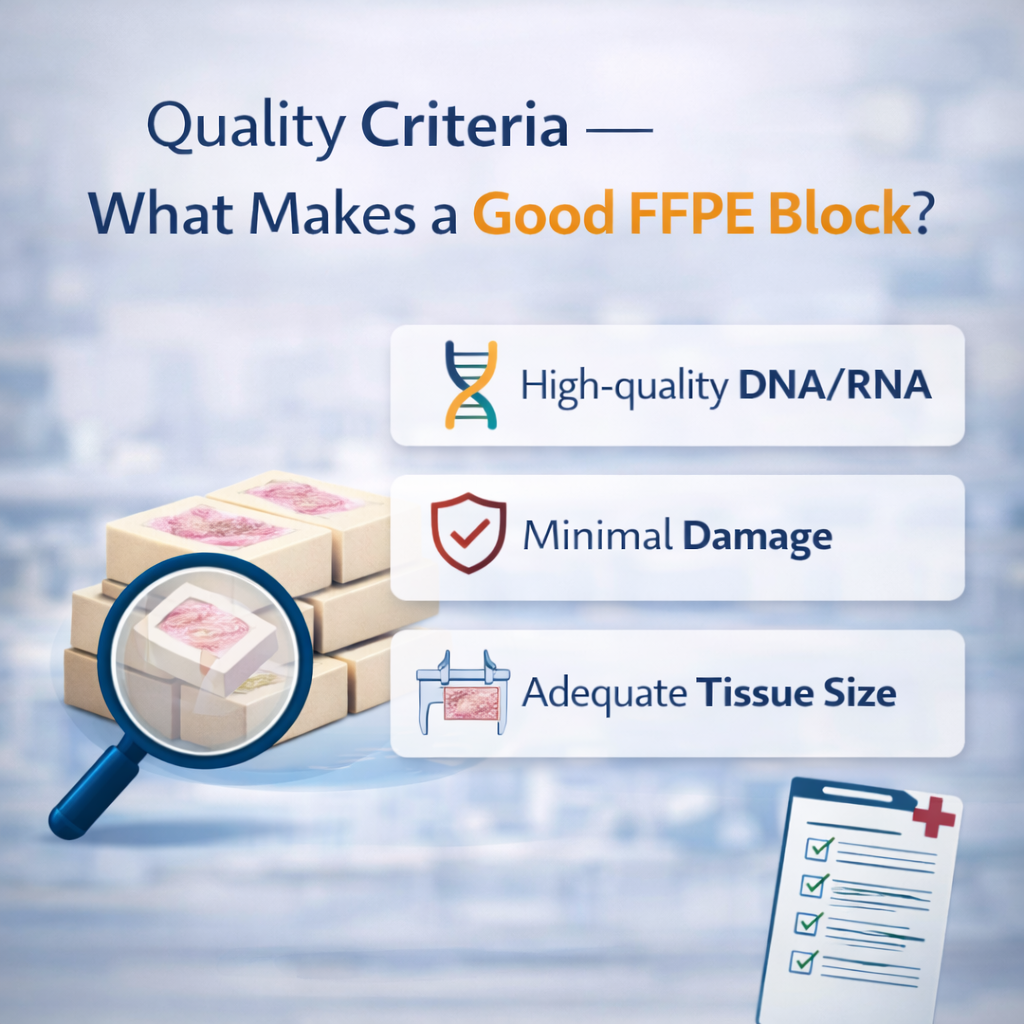
Not all FFPE blocks are research-ready. These are the quality parameters that determine whether a block will yield reliable data:
| Quality Parameter | Optimal Standard |
|---|---|
| Fixation time | 6–72 hours in 10% neutral buffered formalin |
| Tissue size | Minimum 5mm × 5mm for most assays |
| Tumour content | >20% tumour cells (for oncology blocks) |
| Storage conditions | Room temperature, dark, <25°C |
| Storage duration | Typically ≤10 years for molecular work |
| H&E verification | Pathologist-reviewed section confirming tissue quality |
| Clinical annotation | Diagnosis, stage, grade, treatment, outcome data |
Biospecimen Solutions FFPE Repository — What We Offer

Biospecimen Solutions Private Ltd. maintains one of India’s most extensive FFPE block repositories — with over 100,000 FFPE blocks available for immediate research access across a wide range of indications:
- Oncology: Breast, lung, colorectal, cervical, head & neck, gastric, haematological malignancies
- Non-oncology: Cardiovascular, renal, hepatic, neurological, infectious disease tissue
- Matched sets: Primary vs. metastatic, pre- vs. post-treatment, tumour vs. adjacent normal
What comes with every FFPE block order:
- ✅ H&E section reviewed by qualified pathologist
- ✅ Clinical annotation (age, sex, diagnosis, stage, grade, treatment history)
- ✅ IRB-approved collection with informed consent documentation
- ✅ Certificate of Analysis (CoA)
- ✅ Fixation and storage history
- ✅ Sections cut to your specification (3–10 microns)
- ✅ IATA P650 compliant international shipping
All FFPE blocks are sourced, processed, and stored under our ISO 9001 certified and NABL accredited quality management system — ensuring every block you receive meets international research standards.
Conclusion: FFPE Blocks Are Only as Good as Their Source
The scientific value of an FFPE block is entirely dependent on the quality of its collection, fixation, processing, storage, and annotation. A block from a non-accredited source, with unknown fixation history and no clinical data, is a research risk. A block from an ISO-certified, NABL-accredited repository with full documentation is a research asset.
When you need FFPE blocks for research in India — for oncology, genomics, IHC, NGS, or drug development — the source matters as much as the sample.
Frequently Asked Questions
Need FFPE Blocks for Your Research?
Submit a Feasibility Request to Biospecimen Solutions today.
Tell us your indication, tissue type, number of cases, and assay requirements — and our team will identify matching samples from our 100,000+ block repository within 24 hours.

Dr. Nayab Reinaz
Dr. Nayab Reinaz is a Clinical Research Coordinator at Biospecimen Solutions Private Ltd., Bengaluru — an ISO 9001 certified and NABL accredited CRO. She specialises in subject recruitment, informed consent management, ICH-GCP compliant biospecimen collection, and site-level clinical study coordination across oncology, immunology, and genomic research programs.
Table of Contents
Get In Touch
Ready to advance your research? Contact our expert team to discuss your
biospecimen needs
No. 899/2, 1st Floor, MCECHS Layout,
Dr. Shivaram Karanth Nagar, Sampigehalli,
Bengaluru, Karnataka 560077
India
sales@biospecimensolutions.in
Sat-Sun: Closed